
Shares of Avenue Supermarts, which owns and operates the DMart stores, hit a two-year high of Rs 4,710.15 as they surged nearly 6 per cent on the BSE in Thursday's (April 4) intraday trade after reporting strong revenue growth in the January-March quarter (Q4) of the previous financial year (FY24). DMart, in the Q4FY24 pre-quarter update, said the company reported 20 per cent growth in standalone revenue from operations at Rs 12,393 crore, as against Rs 10,337 crore in the third quarter (Q3) of 2022-23 (FY23), driven by a 7 per cent growth in revenue per store and a robust 13 per cent year-on-year (Y-o-Y) increase in store additions. In Q3 of 2021-22, the company reported revenue of Rs 8,606 crore and in Q3 of 2020-21, it posted revenue of Rs 7,303 crore.

'Some risks to this market rally include inflation, erratic weather conditions, rising crude prices, slowing global growth and the resultant impact on domestic exports, escalation in geopolitical tensions.'

'Like all long-term bull markets, the Indian stock market will continue to climb the proverbial wall of worry.'

Ahead of his side's Indian Premier League match against Mumbai Indians, Kolkata Knight Riders assistant coach Abhishek Nayar hailed skipper Shreyas Iyer for his mental strength and positive approach to life.

Manufacturing activities in India accelerated further and touched a four-month high in April, boosted by robust new business growth, mild price pressures, better international sales, and improving supply-chain conditions, a monthly survey said on Monday. The seasonally adjusted S&P Global India Manufacturing Purchasing Managers' Index (PMI) increased from 56.4 in March to 57.2 in April, indicating the fastest improvement in the health of the sector so far this year. The March PMI data pointed to an improvement in overall operating conditions for the 22nd straight month.

The Indian services sector expanded at the strongest rate in 12 years in February supported by favourable demand conditions and new business gains, a monthly survey said on Friday. The seasonally adjusted S&P Global India Services PMI Business Activity Index rose from 57.2 in January to 59.4 in February -- its highest level in 12 years. For the 19th straight month, the headline figure was above the neutral 50 threshold. In Purchasing Managers' Index (PMI) parlance, a print above 50 means expansion while a score below 50 denotes contraction.

The Reserve Bank of India on Friday raised the GDP growth projection for the current fiscal to 7 per cent from 6.5 per cent earlier on buoyant domestic demand and higher capacity utilisation in the manufacturing sector. Announcing the bi-monthly monetary policy, RBI Governor Shaktikanta Das, however, flagged protracted geopolitical turmoil and global economic fragmentation as risks to the growth outlook. The RBI kept interest rates unchanged at 6.5 per cent in Friday's monetary policy statement.

In a bid to enhance its equity exposure and earn higher returns for its nearly 65 million subscribers, the Employees' Provident Fund Organisation (EPFO) is considering reinvesting 50 per cent of its exchange-traded funds (ETFs) redemption proceeds back into equity. Sources close to the development said a proposal regarding this was discussed in the investment committee (IC) meeting in October last year, and the recommendation has been sent to the Central Board of Trustees (CBT), the apex decision-making body of the EPFO for its approval. The next CBT meeting is scheduled to be held on Saturday.

Indian equity markets have a limited upside potential in the near-term as they negotiate the ensuing cyclical slowdown, wrote analysts at Nomura in a recent coauthored report led by Saion Mukherjee, their managing director and head of equity research for India. He, however, believes that the foundations are in place for sustainable growth over the medium-to-long term, and hence suggests a 'buy on dips' strategy to equity investors. As an investment strategy, Nomura prefers domestic-oriented sectors and companies over exporters, and prefers stocks that provide valuation comfort. Industrials and banks are their overweight sectors, while IT services and consumer discretionary are their underweight sectors.

Decisions should not be based on feelings, such as optimism or pessimism about the stock market or specific investment products, suggests Avinash Luthria.

Stocks of small- and mid-cap companies continued to gain ground in July, notwithstanding analysts sounding caution on these two market segments given the sharp run thus far in calendar year 2023 (CY23). Sanjeev Prasad, co-head of Kotak Institutional Equities, in a note co-authored with Anindya Bhowmik and Sunita Baldawa in June-end, had cautioned against the sharp run in small- and mid-caps. "We do not see any particular reason for the excitement in small- and mid-cap stocks.

'Liquid ETFs help in cash management by enabling a smooth transition between equity and cash within the same settlement cycle, as they trade in the same segment as equity.'

The move to demerge the hotel business into a separate entity by ITC has brought back focus on hotel stocks, which have already seen a good run thus far in fiscal 2023-24 (FY24). Analysts believe there could be more gains in store over the next one year for the stocks in this sector, but suggest investors put in money on a correction only from a long-term perspective. Hotel stocks, according to A K Prabhakar, head of research at IDBI Capital, have seen a good run as travel picked up post Covid in India. Not only have the room rents increased, the occupancy, too, has surged.

The domestic equity markets are expected to extend gains following the strong showing of the Narendra Modi-led Bharatiya Janata Party (BJP) in the state elections - a crucial precursor to the general elections in May. The BJP decisively secured victories in three of the four key states - Madhya Pradesh, Rajasthan, and Chhattisgarh. While the battles in these three states were closely contested, the scale of the BJP's triumph has surprised many, heightening expectations for regime continuity in 2024 - a positive catalyst for the markets.
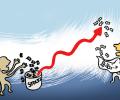
Foreign portfolio investors (FPIs) sold shares worth Rs 20,170 crore ($2.4 billion) recently. This marked the fifth-highest weekly outflow from overseas funds since the beginning of 2008 and the largest since the last week of March 2020. Due to the Covid scare, FPIs had sold shares worth Rs 21,951 crore during that week, causing the market to decline by nearly 20 per cent.

Indian economy is expected to clock an average growth rate of 6.7 per cent till 2026-27 fiscal driven by domestic consumption, S&P Global Ratings senior Economist (Asia Pacific) Vishrut Rana said on Wednesday. He said the economic growth in the current fiscal is expected to come in around 6 per cent, lower than 7.2 per cent clocked in 2022-23. "We are seeing some headwinds from the trade side which is affecting activity and that is one of the factors that is affecting growth this year," Rana said at a webinar.

The 55 basis point (bps) spike in the US 10-year bond yield, triggered by a combination of FOMC's hawkish commentary and BOJ's relaxation of the yield control curve (YCC) has made analysts cautious on Asian equities and expect them to trade sideways in the short-to-medium term.

Shares of paint companies faced pressure, falling up to 5 per cent on the BSE in Monday's (February 26) intraday trade amid concerns that Grasim Industries' entry into the paint sector will intensify the competition. Asian Paints reached a 10-month low of Rs 2,850, slipping nearly 5 per cent after brokerage firm CLSA downgraded the stock following the Birla Opus launch. The paint maker's stock traded at its lowest level since April 28, 2023.

The cash pile within smallcap mutual fund (MF) schemes has grown over the past few months amid a relentless rally in stocks in this space. While fund managers usually don't make cash calls, incessant inflows and valuation discomfort have forced their hand. At the end of January, the top 10 schemes had over Rs 12,160 crore in cash, compared to Rs 8,700 crore in August 2023.

Notwithstanding the recent sharp decline in the stocks of public sector companies, analysts at Jefferies remain bullish on this segment. State Bank of India, Coal India, and NTPC are their top picks in this space, they said in a recent note. The public sector undertaking (PSU) or state-owned enterprise (SOE) index, with a 70-percentage-point outperformance versus the National Stock Exchange Nifty50 over the past 12 months, comes after a decade of underperformance before 2020.

Polarisation in the performance of Indian banks will persist as many large public sector banks are still saddled with weak assets, high credit costs, and poor earnings, S&P Global Ratings said on Thursday. It said State Bank of India and leading private sector banks have largely addressed their asset quality challenges, and their profitability is improving more sharply than the banking system. In its Global Banking Outlook-2023 report, S&P said economic recovery is driving credit costs to cyclical low levels and stronger balance sheets and higher demand should boost bank loan growth, but deposit growth will lag.

Major laggards among Sensex constituents included Bharti Airtel, Hindustan Unilever, Tata Steel and ITC. Power Grid, UltraTech Cement, NTPC and Titan emerged as winners.

S&P Global Ratings on Monday cut India's economic growth forecast for current fiscal year to 7 per cent, but said the domestic demand-led economy will be less impacted by the global slowdown. S&P had in September projected the Indian economy to grow 7.3 per cent in 2022-23 and 6.5 per cent in next fiscal year (2023-24). "The global slowdown will have less impact on domestic demand-led economies such as India... India's output will expand 7 per cent in fiscal year 2022-2023 and 6 per cent in next fiscal year," S&P Global Ratings Asia-Pacific chief economist Louis Kuijs said.

The growth momentum in India's manufacturing sector was maintained in February, with new orders and output increasing at similar rates to January, according to a monthly survey. The seasonally adjusted S&P Global India Manufacturing Purchasing Managers' Index (PMI) was at 55.3 in February, little-changed from 55.4 in January. The February PMI data pointed to an improvement in overall operating conditions for the 20th straight month. In PMI parlance, a print above 50 means expansion while a score below 50 indicates contraction.

Water projects firm Vishnu Prakash R Punglia, the 20th company to launch its IPO in the current year, saw its shares closing at a 47 per cent gain over its issue price on Tuesday. Such a huge one-day pop is considered rare; however, it has become the norm this year. The average listing-day gain for these 20 IPOs in 2023 is 34 per cent, and their average gain to date stands at 46 per cent.

The RBI's decision to tighten norms for unsecured personal loans is credit positive because lenders will need to allocate higher capital for such loans, thus improving their loss-absorbing buffers, Moody's Investors Service said on Monday. The Reserve Bank last week raised risk weights on unsecured retail loans, credit cards and lending to non-banking finance companies (NBFCs) by 25 percentage points. Moody's said unsecured loans have been growing rapidly in the past few years, exposing financial institutions to a potential spike in credit costs in case of sudden economic or interest rate shocks.

The Indian services sector growth touched a six-month high in December, supported by a robust intake of new work and favourable market conditions, a monthly survey said on Wednesday. The seasonally adjusted S&P Global India Services PMI Business Activity Index rose from 56.4 in November to 58.5 in December, highlighting the strongest rate of expansion since mid-2022. For the 17th straight month, the headline figure was above the neutral 50 threshold.

Analysts have given a thumbs up to the Reliance Industries (RIL) and Walt Disney Co. (Disney) proposed a joint venture (JV). The stock of the Mukesh Ambani-controlled company gained nearly 1.5 per cent on Thursday to Rs 2,952 levels as compared to the S&P BSE Sensex that traded marginally weak, down 0.2 per cent to 72,172 levels in intra-day trades.

S&P Global Ratings on Tuesday said there will not be any significant direct financial spillover risks because of the problems being faced by the Adani group, though there can be some secondary impact such as banks undertaking extra due diligence while giving loans to corporate. S&P senior director (infrastructure & utilities ratings), Abhishek Dangra said as per external estimates, the exposure of the banking sector to Adani group companies is less than 1 per cent and also the credit ratings of the firms are not at 'distress level'.


With sentiment for the automotive (auto) sector turning positive, stocks of two-wheeler auto majors have been hitting their 52-week highs. Hero MotoCorp, Bajaj Auto, TVS Motor Company, and Eicher Motors recently reached their yearly highs on strong sales in the festival season and the expectation of faster growth rates ahead. Since the start of this month, listed two-wheeler majors have delivered returns in the 12-17 per cent range, compared to the 7 per cent gains for the S&P BSE Auto Index and 3 per cent for the benchmark S&P BSE Sensex.

Life Insurance Corporation of India (LIC) February 8 for the first time ever crossed the Rs 7 trillion market capitalisation, as the stock price of state-owned insurer hit a new high of Rs 1,144,45, on rallying 10 per cent on the BSE. The board of directors of the Corporation are scheduled to meet today i.e. February 8, 2024, to consider a proposal for declaration of interim dividend for the financial year 2023-24 (FY24). The board will also consider and approve the unaudited financial results for the quarter and nine-month period ended on December 31, 2023.

S&P Global Ratings on Thursday said about half of the Indian companies that it rates are getting a boost in their core profitability from rupee depreciation. "Much of our rated India corporate portfolio has sizable US-dollar linked revenue and, therefore, is not exposed to rupee depreciation. "This encompasses entities in the IT, metals, and chemicals sectors. About half of the firms we rate are getting an EBITDA boost from currency weakening," the US-based rating agency said in a report.
Among the Sensex firms, ITC, NTPC, Axis Bank, Larsen & Toubro, Bajaj Finance, Asian Paints and Tata Steel were the major gainers. Mahindra & Mahindra, Wipro, Maruti, IndusInd Bank, Kotak Mahindra Bank and HDFC Bank were among the laggards.

Boom, bust or a bit of both: as the jury bides time before ruling on the US 'recession', the economy's vital signs at a perplexing time of high-interest rates, still-punishing inflation, and surprisingly strong economic gains are a study of a growing debate over whether the world's largest economy is barrelling into a new downturn. With the US Federal Reserve's (Fed's) inflation fighters attempting the risky pursuit of 'pillow-soft landings' and its economy sending out mixed signals, if there is indeed a recession, it could spell trouble for domestic equities and corporate earnings growth.

rediffGURU Ramalingam Kalirajan answers your personal finance queries.

ITC stock slipped over 4 per cent on Thursday (February 8) after British American Tobacco (BAT) said it could sell some of its stake in the company, recovering partially in trade. The stock of the cigarette-to-hotels conglomerate traded at Rs 420 levels, rising 1.3 per cent in intraday deals as compared to the S&P BSE Sensex that traded flat for most part of the day. The development, meanwhile, saw Jefferies downgrade the stock to 'hold' from 'buy' earlier with a target price of Rs 430, down a huge 17.3 per cent from its earlier price target of Rs 520.
Global trends, trading activity of foreign investors, outcome of state elections and RBI's interest rate decision are the major factors that will drive the movement in the domestic equity markets this week, analysts said. "Global markets are currently in a fabulous mood. The US 10-year bond yield and the dollar index are also cooling off, which gives strength to the market. These factors will be closely monitored, as they have the potential to influence market sentiment," said Pravesh Gour, senior technical analyst, Swastika Investmart Ltd. On the political front, the results of assembly elections in five states are eagerly anticipated, Gour said.

South Korean auto giant Hyundai Motor Company is considering tax implications of listing its Indian unit before taking a final call, according to sources privy to the development. Hyundai Motor is mulling an initial public offering (IPO) for its Indian arm to raise around $3 billion (at a valuation of up to $30 billion), and talks are in the early stages between the company and bankers, banking sources revealed. Hyundai Motor India Ltd (HMIL), however, declined to comment on the development.

India's manufacturing sector activity moderated in January amid slower increase in total sales, and headcounts were broadly unchanged amid sufficient staff numbers to cope with current requirements, according to a monthly survey. The seasonally adjusted S&P Global India Manufacturing Purchasing Managers' Index (PMI) fell from December's recent high of 57.8 to 55.4 in January, as factory orders and production rose at sharp, albeit slower, rate. The January PMI data pointed to an improvement in overall operating conditions for the 19th straight month.
